The process of creating 3D content is changing rapidly. In the past, transforming an idea into a 3D object usually required professional modeling skills, complex software, and a long production process. A simple concept could take days or even weeks before becoming a complete digital model.
Today, artificial intelligence is changing this workflow.
With AI-powered 3D technology, creators can start from simpler materials such as images, sketches, and descriptions, and quickly explore three-dimensional possibilities. This development is opening new opportunities for designers, artists, product developers, and individual creators who want to turn creative ideas into physical objects.
However, creating a useful 3D model requires more than simply generating a shape. A successful AI-generated model needs accurate structure, detailed surfaces, and enough quality to support further development or printing.
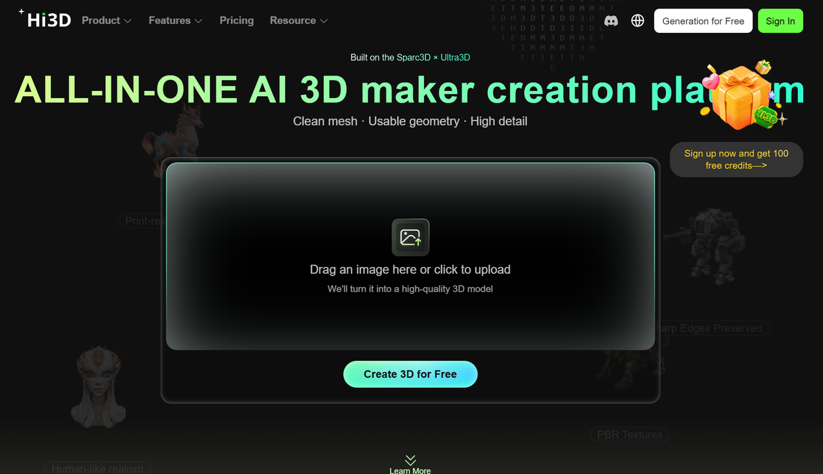
Hi3D focuses on solving these challenges. By combining AI image-to-3D generation, intelligent texture creation, and practical printing preparation tools, Hi3D helps users transform visual concepts into complete 3D assets.
With the official release of Hi3D V3.0, the AI 3D creation process becomes more powerful. The new version improves reconstruction accuracy, structural understanding, and texture quality, helping creators move from a simple image or idea to a more detailed and usable 3D model.
1. The Rise of Image-Based 3D Creation in the AI Era
Images have always been an important source of inspiration for creators.
A drawing, product image, character design, or personal photo can contain the foundation of a creative project. However, turning these two-dimensional materials into three-dimensional objects has traditionally required advanced modeling skills.
AI is changing this process by allowing images to become the starting point of 3D creation.
1.1 Why Image-to-3D Technology Matters
Traditional 3D modeling requires creators to manually build shapes, adjust surfaces, and refine details. While professional designers can complete these tasks, the process remains challenging for many users.
For creators who already have visual ideas, the biggest challenge is not imagination but transformation.
They may know exactly what they want to create, but they lack the technical ability to build the model from the beginning.
AI image-to-3D technology provides a new solution.
Instead of starting with an empty modeling workspace, creators can begin with existing visual references and allow AI to help generate the initial 3D structure.
1.2 Expanding Access to 3D Creation
The development of AI 3D technology lowers the technical barrier for many users.
Artists can explore how their illustrations appear in three dimensions. Designers can quickly test product concepts. Small creative teams can develop prototypes without relying entirely on traditional modeling workflows.
Hi3D supports this change by making AI-assisted 3D creation easier and more accessible.
As an AI 3D model maker, Hi3D helps users transform creative ideas into three-dimensional assets while reducing the complexity of traditional workflows.
2. Turning Visual Concepts into 3D Models with Hi3D
One of the most important capabilities of AI 3D technology is the ability to convert existing visual information into digital models.
Hi3D provides users with tools that help bridge the gap between 2D creativity and 3D production.
2.1 Transforming Images into Detailed 3D Assets
A single image can represent a complete creative vision.
For example, an illustrator may create a character design that they want to turn into a collectible figure. A product designer may have a concept image that needs to become a prototype. A creator may want to transform a personal picture into a customized object.
With photo to 3D model technology, Hi3D allows users to convert visual references into three-dimensional models through AI.
The system analyzes the information contained in the image and generates a corresponding 3D structure, helping users create a starting point for further editing, visualization, or printing.
This process reduces the time and technical knowledge traditionally required for 3D modeling.
2.2 Helping Creators Preserve Their Original Ideas
One important advantage of AI-based generation is that it allows creators to focus on their original concepts.
Instead of spending most of their time constructing basic geometry, creators can spend more effort improving design details, exploring variations, and developing creative directions.
For artists and designers, this means more freedom to experiment.
For beginners, it provides an easier way to enter the world of 3D creation.
2.3 From Text Descriptions to 3D Possibilities
Visual references are not the only way to start a 3D project.
Sometimes the first step is simply a description.
A creator may imagine a futuristic product, a fantasy character, or a unique object that does not exist yet.
Text-based AI generation provides another way to explore these ideas.
By combining image and text-based creation methods, Hi3D gives users more flexibility when developing new concepts.
3. AI Texture Generation Improves the Complete 3D Experience
A model’s shape creates its foundation, but texture gives it identity.
Colors, materials, patterns, and surface details determine how a 3D object looks and feels.
For many applications, especially character design, collectibles, and product visualization, texture quality directly affects the final result.
3.1 The Difficulty of Traditional Texture Creation
Texture creation has traditionally been another technical challenge in 3D workflows.
Creators often need additional knowledge of UV mapping, material design, and digital painting.
Even after completing a model, adding realistic and detailed textures can require significant time.
This creates another barrier for users who want to create high-quality 3D assets.
3.2 Creating Better Surfaces with AI
Hi3D improves this stage through AI-powered texture generation.
The AI 3D model texture generator capability helps creators generate detailed surface information more efficiently.
Instead of manually creating every visual element, users can use AI assistance to develop textures that match the structure and style of their models.
This helps improve the overall quality of AI-generated assets and makes them more suitable for creative applications.
Whether creating a collectible, a prototype, or an artistic model, better textures help bring digital ideas closer to reality.
4. Hi3D V3.0 Official Release: A New Generation of AI 3D Model Creation
The launch of Hi3D V3.0 represents a major improvement in AI-powered 3D generation.
As AI 3D technology develops, users are no longer satisfied with simply obtaining a generated model. They need models that are accurate, detailed, and practical enough for real creative workflows.
Hi3D V3.0 focuses on improving these important areas.
4.1 Higher Reconstruction Accuracy with 2048³ Voxel-Level Technology
One of the most significant upgrades in Hi3D V3.0 is the improvement of geometric reconstruction.
The new version increases reconstruction resolution to 2048³ voxel-level and becomes the first commercially available AI 3D model with this level of high-precision capability.
This improvement allows AI-generated models to capture more details from original inputs.
Fine structures, complex surfaces, small design elements, and detailed shapes can achieve clearer reconstruction results.
For image-based 3D creation, higher accuracy means the generated model can better represent the original visual concept.
This is especially valuable for creators working on detailed characters, product prototypes, and customized designs.
4.2 Understanding Complex Objects from Multiple Perspectives
Generating a 3D model from a single image is challenging because important information may not be visible.
AI needs to understand how different parts connect and how the object should exist in three-dimensional space.
Hi3D V3.0 improves cross-view structure reasoning, helping generated models maintain better consistency across different angles.
This improvement allows creators to achieve more complete models instead of only optimizing the visible front view.
For complex designs, better structural understanding creates a smoother workflow from generation to final application.
4.3 Higher-Quality Textures with 8K Output
Visual details are another major focus of Hi3D V3.0.
The latest version increases texture output capability up to 8K resolution and upgrades its self-developed UV completion algorithm. These improvements enhance texture clarity, detail preservation, and overall surface quality.
For creators, this means AI-generated models can achieve a more polished appearance.
Higher-quality textures are especially useful for digital presentation, product visualization, and physical printing.
5. Hi3D V3.0 Evolution: From AI Generation to Complete Creative Workflow
The development of Hi3D reflects the continuous improvement of AI 3D technology.
Each version has focused on expanding what users can achieve.
5.1 Hi3D V1.0: Making AI 3D Generation Possible
Hi3D V1.0 introduced AI-powered 3D generation and provided users with a new way to create models from images.
It helped demonstrate the potential of AI in simplifying traditional 3D workflows.
5.2 Hi3D V2.0: Adding More Complete Model Creation
Hi3D V2.0 expanded beyond basic generation by improving model completeness and adding stronger texture-related capabilities.
This helped AI-generated models become more visually complete.
5.3 Hi3D V3.0: Creating More Practical AI 3D Assets
Hi3D V3.0 represents a further step toward practical AI 3D production.
The new version improves reconstruction accuracy, structure understanding, texture quality, and workflow capabilities. It also strengthens features related to printing preparation and model usability.
This evolution shows that AI 3D technology is moving from experimental creation toward real-world applications.
See also: Tech Updates Unveiling the Latest in Innovation
6. Supporting the Complete Journey from Model Generation to Printing
Creating a high-quality model is only part of the 3D workflow.
To help users transform digital assets into physical objects, Hi3D also provides additional printing preparation features.
6.1 Multi-Color Printing Creates More Expressive Physical Models
Many creative objects depend on color to communicate their identity.
Characters, collectibles, and personalized products often require multiple colors to achieve the intended appearance.
Hi3D’s multi-color printing capability helps convert textured AI models into printable multi-color objects, creating more detailed and expressive results.
This helps connect digital creativity with physical production.
6.2 Split-for-Printing Helps Handle Complex Designs
Some models cannot be printed as a single piece because of their size or structure.
Hi3D’s split-for-printing function helps divide models into suitable parts and generate connectors for easier assembly.
This makes larger and more complex projects easier to manage.
6.3 Smart Arrangement Improves Printing Preparation
Preparing a model before printing requires careful consideration of placement and organization.
Hi3D’s smart arrangement feature helps users optimize model placement and improve printing preparation efficiency.
These supporting tools help create a smoother transition from AI generation to physical output.
7. How Hi3D V3.0 Is Expanding Creative Possibilities Across Industries
The influence of AI 3D creation is expanding into many fields.
7.1 Character Design and Digital Art
Artists and creators can transform illustrations into 3D assets, opening new possibilities for collectibles, digital content, and creative products.
7.2 Product Development and Prototyping
Designers can use AI-generated models to test concepts faster and reduce early development time.
7.3 Personalized Manufacturing
Businesses can explore customized products and smaller production runs with more flexible workflows.
Hi3D V3.0 supports these applications by providing more accurate and complete AI-generated 3D assets.
8. Experience Hi3D V3.0 with 48-Hour Free Access
The official release of Hi3D V3.0 opens a new chapter for AI-powered 3D creation.
To celebrate the launch, Hi3D provides a 48-hour free experience period. During this time, users can explore Hi3D V3.0 without generation limits and experience its latest features freely.
Creators can try AI model generation, AI texture creation, and printing preparation functions without restrictions.
After the 48-hour free experience ends, Hi3D will also provide a 70% discount promotion, allowing more users to continue exploring AI-powered 3D creation.
From a single image to a complete 3D object, Hi3D V3.0 is making the process of creation simpler, faster, and more accessible.
The future of 3D creation is not limited to professionals. With AI, more people can transform their ideas into real three-dimensional experiences.
