Every Amity University Online student eventually faces the same challenge — writing and submitting the Amity Project. It sounds straightforward at first, but the official guidelines are detailed and non-negotiable. This guide breaks down everything you need to know, from choosing a compelling topic to acing your Viva submission, so your project is accepted on the first try.
What Is the Amity Project and Why Does It Matter?
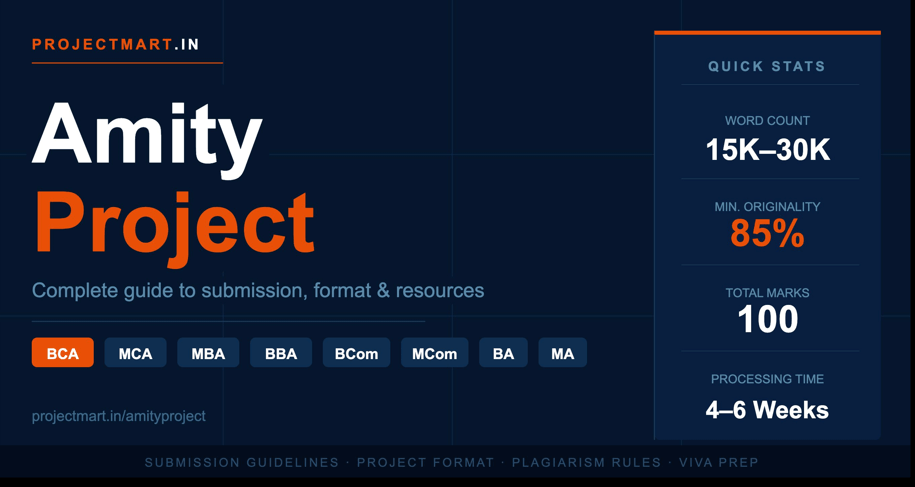
The Amity Project is a mandatory academic requirement for students enrolled in programmes like BCA, MCA, MBA, BBA, BCom, MCom, BA, and MA at Amity University Online. It carries a total of 100 marks — 70 for the Project Report and 30 for the Viva — making it one of the highest-weighted individual assessments of your degree.
According to the official Amity Project Work Guidelines, project-based learning “is the application of comprehensive methodology to inculcate the spirit of strategizing industry operations in a real-time environment.” In plain terms, it is your chance to prove you can apply what you have studied to a real-world context. A well-written Amity Project does not just fulfil a requirement — it shapes how you think professionally.
Choosing the Right Topic: The Foundation of a Good Project
The most common reason projects are rejected is a poorly chosen or irrelevant topic. Before you write a single word, ensure your topic meets Amity’s official criteria:
- It must be relevant to business or technology, defined broadly.
- It must relate to one or more subjects within your core programme and specialisation.
- It must be clearly focused enough for in-depth study.
- It must have adequate sources of information available.
- It must offer genuine value to your personal and professional development.
Also remember the important distinction between topic and title. The topic is the area you want to investigate. The title — which must not exceed 12 words — may not be finalised until the project is written so it accurately reflects your content.
Amity Project by Programme — Where to Start
Different programmes require different approaches. Here are the dedicated project resources for each course:
- Amity BCA Project — Bachelor of Computer Applications
- Amity MCA Project — Master of Computer Applications
- Amity BBA Project — Bachelor of Business Administration
- Amity MBA Project — Master of Business Administration
- Amity BCom Project — Bachelor of Commerce
- Amity MCom Project — Master of Commerce
- Amity BA Project — Bachelor of Arts
- Amity MA Project — Master of Arts
Formatting Requirements You Cannot Ignore
The writing format is strictly specified in Amity’s official guidelines. Failure to comply leads to automatic rejection:
- Font: Times New Roman, size 12
- Line Spacing: Double-spaced
- Margins: 1 inch (2.5 cm) all around
- Citations: APA Style Guide, 6th edition
- Spelling: American English — “organize” not “organise”; “center” not “centre”
- File Format: .pdf or .docx, maximum 2 MB
- Running Head: A page header on every page
The Extended Abstract: Your First Submission Stage
The extended abstract (3,000–5,000 words) must be submitted before your full report. It contains six mandatory sections:
- Abstract (500–1,000 words): A standalone overview of the entire project
- Study Hypotheses: Null or alternative hypotheses where applicable
- Literature Review: Critical evaluation of previous research on your topic
- Research Methodology: Design, sampling, data collection, and analysis methods
- Results: Interpreted findings and concrete recommendations
- Implications: Theoretical and practical significance of the study
This abstract goes in alongside your Project Guide’s resume — a postgraduate professional with a minimum of 10 years of work experience.
Plagiarism Rules: The 85% Originality Threshold
Amity requires a minimum 85% originality in your submitted project. This means no more than 15% of your work can match existing sources. A plagiarism report is mandatory and must be submitted along with your full project report. Any project exceeding 15% plagiarism is automatically rejected and sent back for resubmission — at the cost of academic delays and extension fees.
This is why using a service like ProjectMart — which provides originally written, course-specific project reports formatted to Amity’s exact standards — makes a significant difference.
The 3-Stage Submission Process
Complete Amity Project submission is not a single upload. It consists of three sequential stages:
- Stage 1: Extended Abstract + Project Guide Resume
- Stage 2: Full Project Report (15,000–30,000 words) + Plagiarism Report
- Stage 3: Viva — 5 descriptive questions about your specific project (answered online after file upload)
Project submission is considered complete only when all three stages are done. Missing any stage results in academic delinquency and extension fees.
See also: What Are the 4 Types of Businesses?
Final Word: Write It Right the First Time
An Amity Project is not just a box to tick — it is a professional exercise that can define your academic completion timeline. Every formatting error, every missing certificate, and every sign of plagiarism is a reason for rejection and delay. Take the guidelines seriously, plan your stages, and use the right resources.
Visit www.projectmart.in/amityproject to explore course-specific project topics, synopses, and fully formatted reports — built to Amity University’s exact requirements.
