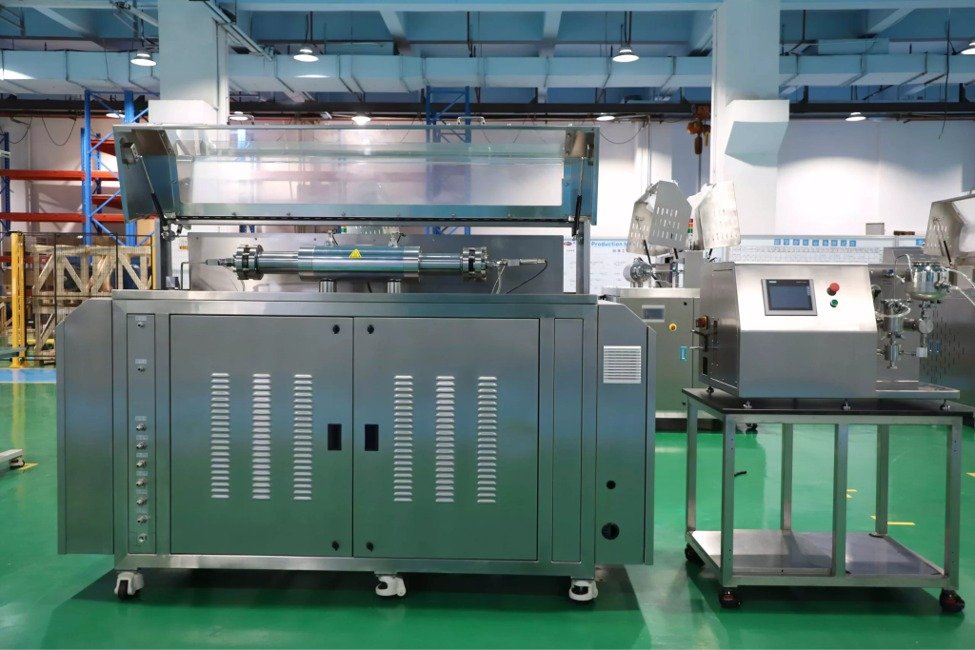
As advanced materials become more complex, precise control of particle size, dispersion, stability, and uniformity is increasingly important. Conventional mixing methods often struggle to deliver consistent results.
Microfluidic high pressure homogenization addresses these challenges by forcing materials through specialized interaction chambers under high pressure. Intense shear, turbulence, and cavitation help reduce particle size, break down agglomerates, and improve dispersion, supporting both laboratory research and scalable production.
What Is Microfluidic High Pressure Homogenization?
Microfluidic high pressure homogenization is a processing technology for suspensions, emulsions, and complex material systems. A high-pressure booster drives materials through an engineered interaction chamber, where localized mechanical forces improve particle distribution and structural uniformity.
Unlike conventional stirring, this process creates controlled microscale interactions that can influence the properties and consistency of the final product.
Key Applications in Nanotechnology
Nanotechnology requires not only nanoscale particle production but also uniform dispersion and long-term stability. A microfluidic homogenizer helps researchers optimize these properties across several applications:
- Nanoparticle dispersion: Breaks down agglomerates in ceramic nanoparticles, metal oxides, graphene, coatings, and battery materials.
- Liposomes and lipid nanoparticles: Supports formulation development by enabling systematic optimization of pressure, processing cycles, and temperature.
- Nanoemulsions: Reduces droplet size and improves distribution for pharmaceutical, cosmetic, food, and specialty chemical formulations.
- Advanced materials: Supports research into conductive materials, functional ceramics, and energy storage components.
How Does a Microfluidic Homogenizer Work?
A typical system integrates a high-pressure booster, pressure controls, pipelines, and an interaction chamber.
Feed Material → Pressurization → Microfluidic Interaction → Particle Disruption → Homogeneous Product
Processing pressure, chamber geometry, temperature, and cycle count should be optimized according to material characteristics to achieve repeatable results.
Key Advantages
- Particle size control: Helps reduce particle size and agglomeration.
- Improved dispersion: Promotes more uniform particle distribution.
- Process consistency: Controlled parameters support repeatable processing.
- Scale-up potential: Facilitates process development from laboratory testing to pilot and industrial production.
- Application flexibility: Supports nanomaterials, emulsions, liposomes, and specialty formulations.
How to Select the Right Microfluidic Homogenizer
Consider pressure stability, minimum sample volume, interaction chamber design, temperature control, process monitoring, scale-up capability, and core-component reliability. These factors help ensure that equipment meets specific research and manufacturing requirements.
JUNJIE Microfluidic Homogenizer for Nanoscale Processing
The JUNJIE microfluidic homogenizer operates at pressures up to 420 MPa. Its diamond interaction chamber supports nanoscale dispersion and emulsification, with reported processing capabilities of 20–50 nm, depending on the material and application.
The all-diamond chamber helps minimize metal contamination risks, making the technology relevant to high-purity material research. Applications include battery materials, graphene exfoliation, and liposome preparation.
Conclusion
Microfluidic high pressure homogenization offers a controllable approach to particle size reduction, dispersion, and emulsification. By evaluating pressure stability, chamber design, temperature management, and scalability, researchers can select a microfluidic homogenizer suited to their material development and production goals.
