
In the hyper-competitive 2026 American educational landscape, the traditional image of the “starving student” is being replaced by the “student strategist.” As tuition costs at private four-year institutions continue to outpace inflation, the contemporary student is no longer just a learner; they are a high-stakes investor.
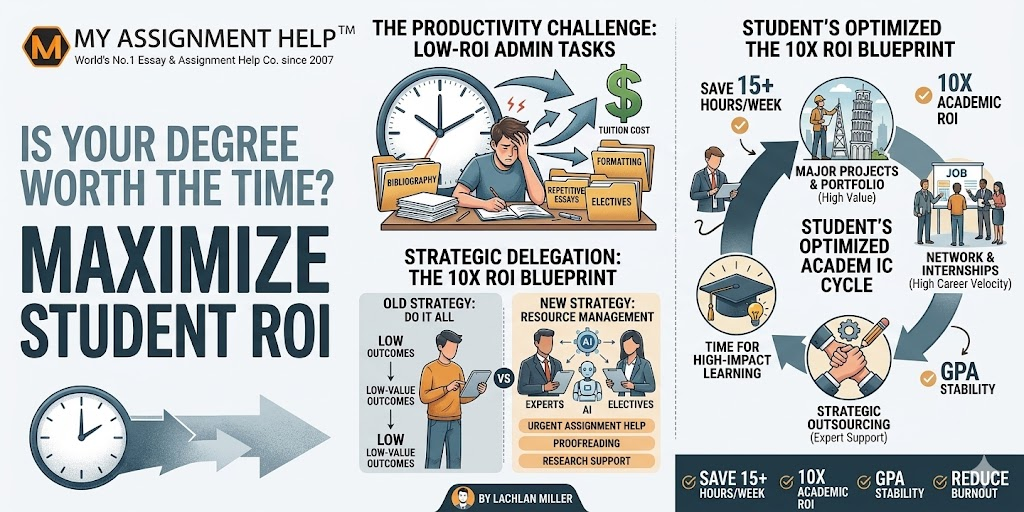
When you are paying upwards of $65,000 a year for a degree at an Ivy League or a premier state school in California or Texas, every hour spent on a task must be analyzed through the lens of Return on Investment (ROI). If an hour spent formatting a bibliography could have been spent at a networking event in Silicon Valley or a high-stakes internship on Wall Street, the opportunity cost is simply too high. This realization has birthed a new academic blueprint: Professional Academic Resource Management.
The Opportunity Cost of the “Busywork” Trap
The US Bureau of Labor Statistics (BLS) consistently reports that elite-tier jobs are increasingly gatekept by real-world experience rather than just a high GPA. For a computer science major at Stanford or a marketing student at NYU, “menial” tasks—such as elective course essays or repetitive data entry—often act as a productivity bottleneck.
According to a 2026 student productivity report, the average undergraduate spends nearly 18 hours a week on administrative or low-impact academic tasks that do not directly contribute to their core professional competency. This is where the pivot happens. To remain competitive, savvy students often turn to MyAssignmentHelp when they need an expert to help me do my assignment during peak seasons. By delegating the heavy lifting of research, students can protect their mental health and focus on the 20% of activities that drive 80% of their career velocity.
Human-Led, AI-Enhanced: The 2026 Quality Standard
A major shift in 2026 is the integration of Generative AI. However, top-tier students aren’t just using raw AI; they are looking for “Human-Led, AI-Enhanced” quality. They recognize that while AI can draft, it lacks the nuanced understanding of US regional academic standards, such as the specific nuances of a California State University marking rubric or an East Coast Ivy’s ethical framework.
Strategic students are now opting to pay someone to do my assignment only when the service guarantees a human expert who uses AI tools for data synthesis but provides the critical thinking that search engines (and professors) now demand. This hybrid approach ensures that the “Investment” part of their degree—the actual learning—isn’t lost to the “Noise” of administrative academic hurdles.
The Student ROI Framework: Time Allocation in 2026
| Activity Type | Direct ROI | Career Impact | Long-term Value |
| Major-Specific Projects | High | Vital for Portfolio | Expert Authority |
| Networking/Internships | Very High | Direct Job Placement | Career Velocity |
| Administrative Tasks | Very Low | None | Technical Compliance |
Data-Driven Benefits of Strategic Delegation
- Grade Stability: Consistent, high-quality submissions lead to a higher baseline GPA, which remains a primary filter for Fortune 500 recruiters.
- Networking Capital: Freeing up 15 hours a week allows for attendance at career fairs and industry mixers that are often held during “peak” assignment weeks.
- Mental Health Preservation: According to the American Psychological Association (APA), academic stress remains a leading cause of burnout. Strategic help provides a necessary safety valve.
Key Takeaways
- Time is Your Most Scarce Resource: Invest your time where the returns (career skills) are highest.
- The Hybrid Advantage: In 2026, successful students use human-led, AI-enhanced services to stay ahead of the curve.
- Focus on Core Competencies: Use expert assistance for elective burdens so you can master your major-specific requirements.
See also: Eco-Friendly Landscaping Design Inspirations
FAQ Section
1. Is academic outsourcing common across all US states?
Yes. From the Ivy Leagues in the Northeast to major state schools in the West, students are increasingly treating their education like a business, delegating non-core tasks to maintain focus on their career trajectory.
2. How does the “Human-Led, AI-Enhanced” model work?
It involves human experts using advanced AI for rapid data gathering and structure, while the human writer ensures the content meets high academic integrity and regional language standards.
3. Why is ROI more important than “doing it all” yourself?
In a saturated job market, a degree alone isn’t enough. ROI is found in the balance between academic credentials and the real-world experiences you gain while getting that degree.
Author Bio
Lachlan Miller holds an M.S. in Educational Leadership and has spent over a decade analyzing student performance metrics across the USA. At MyAssignmentHelp, he specializes in developing data-driven content that helps students bridge the gap between classroom theory and 2026 professional efficiency.
References:
- National Center Education Statistics (NCES) – Trends in College Pricing (2026).
- Bureau of Labor Statistics (BLS) – Employment Projections and Earnings.
- American Psychological Association (APA) – Mental Health in Higher Education.