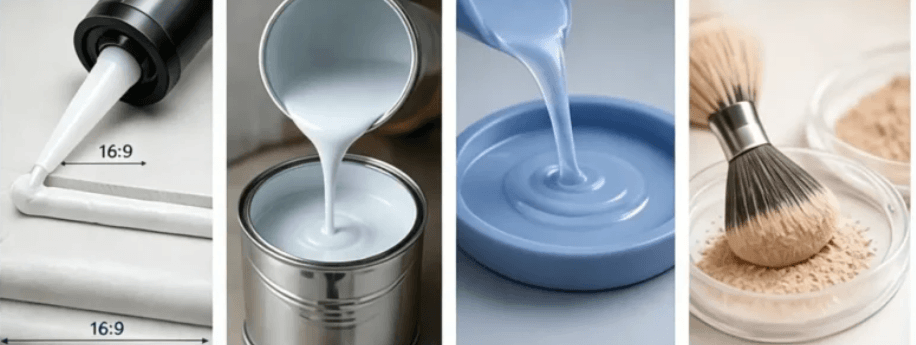
Coating formulators working on projects where moisture resistance is a critical performance requirement frequently turn to hydrophobic fumed silica as a formulation tool capable of addressing multiple performance objectives simultaneously. Beyond its well-known rheological contributions, this surface-treated additive brings a distinct set of benefits specifically relevant to coatings intended for demanding environmental exposure conditions.
Moisture Resistance as a Primary Advantage
The defining characteristic of hydrophobic fumed silica lies in its reduced affinity for water, achieved through surface treatment that replaces many of the naturally reactive silanol groups present on untreated silica with non-polar organic functional groups. Within a coating film, this translates into reduced moisture uptake by the silica component itself, which can contribute to improved overall coating resistance against water absorption and the various degradation mechanisms that moisture ingress can trigger.
This moisture resistance benefit becomes particularly valuable in coatings destined for outdoor exposure, marine environments, or other applications where the finished product will regularly encounter rain, humidity, or direct water contact throughout its service life.
Complementing Primary Barrier Mechanisms
While hydrophobic fumed silica does not replace the fundamental barrier properties provided by the coating’s primary resin system, its contribution to reduced moisture affinity within the film works alongside these primary mechanisms, potentially supporting improved overall resistance to moisture-related coating degradation, including blistering, adhesion loss, and in metal substrate applications, accelerated corrosion initiation.
Rheological Benefits in Non-Polar Coating Systems
Beyond moisture resistance, hydrophobic fumed silica also provides valuable rheology control specifically within non-polar or low-polarity coating systems, such as certain solvent-based and silicone-based formulations, where hydrophilic grades may not disperse as effectively. This makes hydrophobic fumed silica a particularly important formulation tool for coating chemistries that fall outside the polarity range where untreated silica grades perform optimally.
Application-Specific Performance Considerations
Different coating application methods place different demands on hydrophobic fumed silica’s rheological contribution. Spray-applied coatings generally require good flow under the high shear conditions typical of spray application, while still building sufficient structure to prevent sagging once applied to the substrate surface, a balance that well-formulated hydrophobic fumed silica grades can help achieve.
Storage Stability Benefits
Coating formulations incorporating hydrophobic fumed silica in appropriate non-polar systems often demonstrate improved long-term storage stability compared to formulations using less suitable rheology modifiers, since the reduced moisture sensitivity helps maintain more consistent viscosity characteristics even under variable storage humidity conditions over extended shelf periods.
A more detailed technical resource exploring the specific performance benefits and formulation considerations associated with hydrophobic fumed silica in coatings applications, particularly within demanding power system and infrastructure protection contexts, is available at this discussion of hydrophobic fumed silica in coatings performance, which examines these benefits in additional technical depth.
Selecting Appropriate Loading Levels
As with other fumed silica grades, determining the optimal loading level for hydrophobic fumed silica within a specific coating formulation requires systematic testing, balancing the desired rheological and moisture resistance benefits against practical considerations such as coating viscosity, application method compatibility, and overall formulation cost.
Combining with Other Coating Performance Additives
Hydrophobic fumed silica is frequently used alongside other functional additives within comprehensive coating formulations, including UV stabilizers, corrosion inhibitors, and various pigments, requiring formulators to verify compatibility across the full additive package to ensure each component performs its intended function without unwanted interactions.
Frequently Asked Questions
Does hydrophobic fumed silica provide meaningfully better performance than hydrophilic grades in all coating applications? No, performance depends entirely on matching the additive’s surface chemistry to the specific coating system’s polarity, meaning hydrophilic grades often perform better in polar or aqueous coating systems despite the general moisture resistance advantages of hydrophobic grades in non-polar systems.
Can hydrophobic fumed silica be added to water-based coating formulations? While possible in some cases, hydrophobic grades generally present more dispersion challenges in purely aqueous systems, making hydrophilic grades typically the more straightforward choice for water-based coating formulations.
How does hydrophobic fumed silica affect coating gloss and appearance? Depending on loading level and particle characteristics, fumed silica can contribute some degree of matting effect, which formulators should account for when targeting specific gloss level requirements for their finished coating.
See also: How Tinted SPF Simplifies Busy Morning Skincare Routines
Conclusion
Hydrophobic fumed silica in coatings offers formulators a valuable combination of moisture resistance and effective rheology control, particularly relevant for coatings intended for demanding outdoor or moisture-exposed applications. Understanding how to properly select and incorporate this additive helps ensure coating formulations achieve both the application performance and long-term durability required for their intended service environment.
